Grounded in Trusted Data. Guided by Business Context. Delivered in Seconds.
AI can answer almost any question about your business in seconds. Knowing whether the answer is right is a very different problem.
Ask a procurement leader assessing supplier risk, a planner reconciling inventory across regions, or a credit analyst validating loan exposure how much they would trust an AI-generated answer. The hesitation isn’t because AI can’t respond. It’s because a confident answer isn’t always a correct one, and acting on the wrong answer can be expensive.
The challenge isn’t generating answers. It’s enabling AI to reason using the same business language, definitions, and metrics that people already trust.
Bristlecone helped a banking and financial services client build conversational analytics on Microsoft Fabric, enabling business users to ask questions in plain language and receive reliable, explainable answers without changing their existing Power BI environment.
Although this implementation was delivered for a banking client, the challenge is universal. Whether the question is about supplier concentration, inventory exposure, customer profitability, or loan risk, organizations face the same problem: getting reliable answers quickly enough to make confident business decisions.
The Challenge
The dashboards already existed. The data was already there. The challenge lay in everything between the question and the answer.
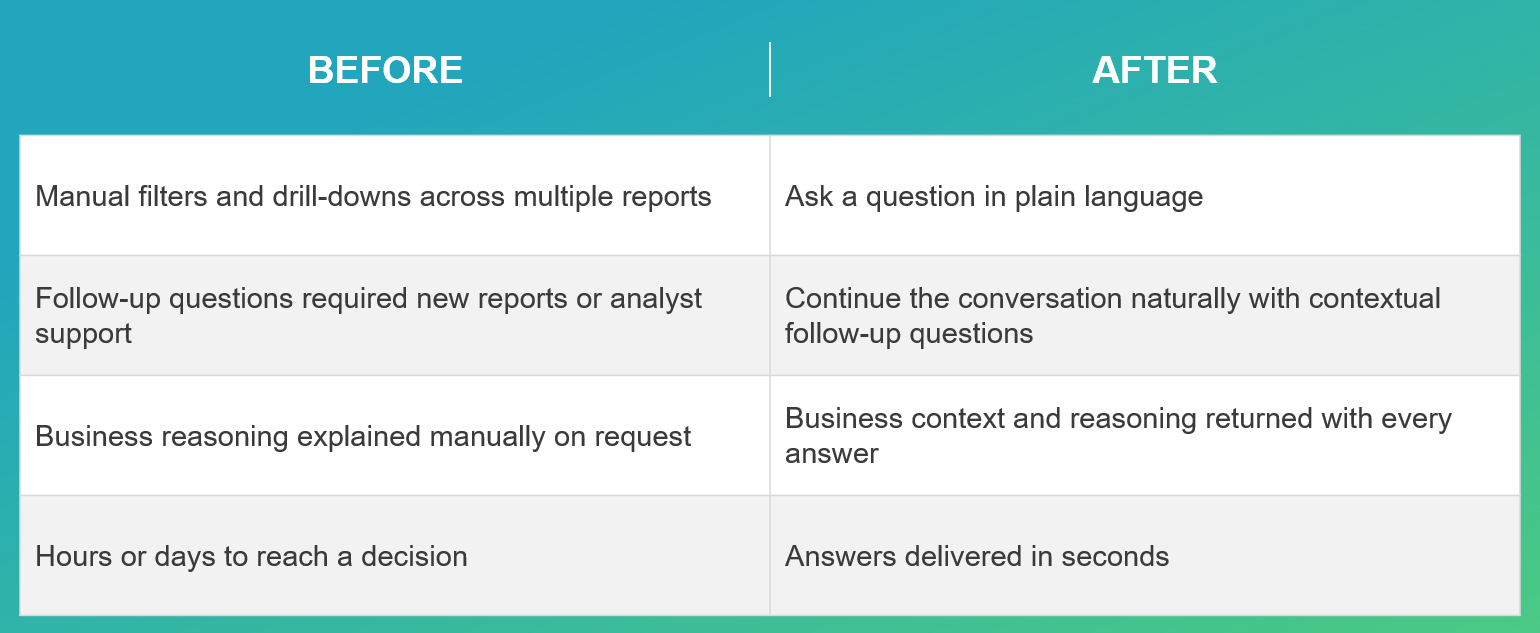
Business users spent valuable time navigating reports, applying filters, drilling into dashboards, and stitching together information from multiple sources simply to answer one business question. When that answer prompted another question, the process started all over again.
What should have taken seconds frequently took hours—or even days. That was the starting point for Bristlecone’s banking and financial services client, and it is a pattern equally familiar across supply chain organizations.
The Approach
Rather than replacing the client’s analytics environment, Bristlecone extended it.
The organization had already invested in Power BI, supported by a Databricks Lakehouse with curated Gold tables feeding an enterprise semantic model. Instead of rebuilding dashboards or introducing another analytics platform, Bristlecone layered Microsoft Fabric’s conversational capabilities directly onto that existing investment.
Business users continue working within the Power BI experience they already know. The difference is that they can now interact with enterprise data conversationally through Copilot instead of navigating report after report.
Technology alone doesn’t create trustworthy AI. The real differentiator was the grounding.
Working closely with business stakeholders, Bristlecone refined the semantic model, clarified KPI definitions, standardized business terminology, enriched metadata, and authored detailed agent instructions that define how the AI should interpret questions and reason through answers.
That grounding enables the agent to understand business language consistently, maintain context across follow-up questions, and deliver answers aligned with enterprise definitions rather than statistically plausible guesses.
The result is conversational analytics that business users can rely on because every response is anchored in the organization’s own business definitions, semantic model, and enterprise data.
The AI Behind the Conversation
The experience feels simple. Behind that simplicity is a sophisticated reasoning process.
When a user asks a question, the Fabric Data Agent:
- Understands the user’s intent using Azure OpenAI.
- Interprets the question using the organization’s semantic model, KPI definitions, and business terminology.
- Generates and executes the appropriate DAX query against governed enterprise data.
- Returns an explainable answer based on the user’s existing Power BI security and permissions.
Rather than searching dashboards or matching keywords, the agent reasons across business definitions and enterprise data to deliver answers that remain consistent with the organization’s reporting standards.
Equally important, every follow-up question builds on the conversation that came before it. Users can investigate issues naturally without repeatedly applying filters or restarting their analysis, making the experience feel less like querying a dashboard and more like collaborating with an experienced analyst.
The result is faster analysis, more intuitive exploration, and greater confidence in every answer.
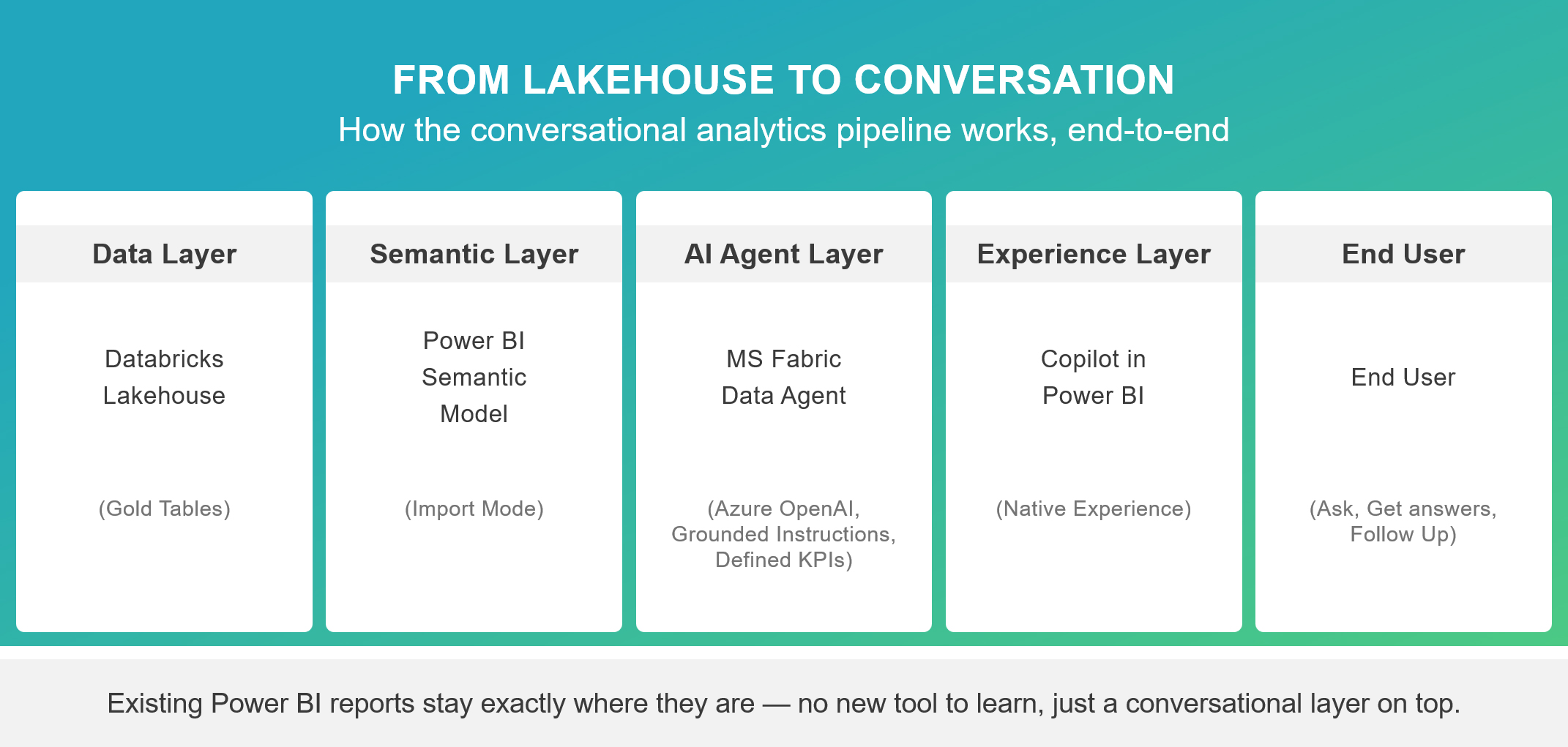
Figure 1: End-to-end architecture—from Databricks Lakehouse and Power BI semantic models to Microsoft Fabric conversational analytics.
From Questions to Conversations
Traditional business intelligence has always been excellent at answering predefined questions. Conversational analytics changes that dynamic.
Instead of searching for reports, users simply ask questions in their own words.
- “Which suppliers have the highest concentration risk?”
- “Why did inventory increase in the South region?”
- “Show only products affected by engineering changes.”
The first answer naturally leads to the next question. The conversation continues. Business context is retained. The user no longer has to restart the analysis every time a new question emerges.
That ability to reason across multiple related questions is what distinguishes conversational analytics from traditional natural language search. Rather than translating one question into one query, the agent supports an evolving dialogue, enabling users to investigate problems the same way they would with an experienced analyst.
The result is not simply faster reporting. It is faster understanding.
See It in Action
The best way to appreciate conversational analytics is to experience it.
In the short demonstration below, a credit analyst moves from a business question to a grounded, context-aware answer in seconds, asking follow-up questions naturally as the conversation evolves. The agent explains the reasoning behind every response while maintaining business context throughout the interaction.
Although the demonstration is based on banking data, the same conversational experience applies equally to supply chain, procurement, manufacturing, operations, finance, and enterprise planning.
▶ Watch the demonstration: Conversational Analytics – Microsoft Fabric Data Agent
Why Bristlecone
This wasn’t a rip-and-replace transformation. It was about unlocking significantly greater value from an analytics platform the client had already invested in.
By extending—not replacing—the client’s existing Power BI environment, Bristlecone enabled business users to interact with enterprise data conversationally, helping them find answers faster, understand the reasoning behind them, and make decisions with greater confidence. That outcome required far more than deploying Microsoft Fabric.
The real differentiator wasn’t the AI. It was the quality of the business foundation beneath it. Working alongside business stakeholders, Bristlecone refined KPI definitions, standardized business terminology, strengthened the semantic model, and authored the guidance that enables the Fabric Data Agent to interpret questions consistently and respond in line with the organization’s business logic.
The result is conversational analytics that feels intuitive for users while remaining accurate, explainable, and aligned with enterprise reporting.
Although this implementation was delivered for a banking and financial services client, the same approach applies wherever organizations rely on Power BI to make business decisions—from supply chain and manufacturing to finance, procurement, and operations.
As conversational analytics becomes part of the enterprise, competitive advantage will come not from AI alone, but from combining enterprise data, business knowledge, and AI to help people make better decisions, faster. The future of business intelligence isn’t another dashboard. It’s a conversation built on enterprise knowledge.
Already using Power BI?
Let’s explore what conversational analytics could look like on top of your existing analytics environment—and how Microsoft Fabric can help your teams ask better questions, find answers faster, and make decisions with greater confidence.
Talk to our Microsoft Fabric experts.

Abhishek Jain
Associate Director – Data Services
Bristlecone

Rohith K
Lead Visualization Specialist – Analytics & BI
Bristlecone