Why Business Context Is Critical for AI in Supply Chains
For decades, enterprises running SAP have faced the same challenge: the moment data leaves SAP, it loses its business meaning.
A table called VBAK means little to a data scientist. A field called KUNNR tells an AI model nothing about customers, relationships, or supply chain context. What exists inside SAP as structured business logic often becomes disconnected technical data once it reaches analytical platforms. For years, the translation layer lived in spreadsheets, legacy documentation, Confluence pages, and the experience of senior SAP consultants — tribal knowledge that rarely scales across modern enterprises.
That approach no longer works in an AI-driven environment.
Nowhere is this challenge more complex than in supply chain.
A single demand plan can simultaneously affect procurement, manufacturing, warehousing, logistics, inventory, and fulfillment. The relationships between materials, plants, inventory positions, purchase orders, production plans, and customer demand are deeply interconnected — but rarely obvious outside SAP itself. That is why the recent Semantic Metadata Sync capability between SAP Business Data Cloud and Databricks Unity Catalog matters far beyond metadata management. It changes how enterprises can operationalize AI on SAP data.
The Shift: SAP Data Retains Its Business Context
With semantic metadata now synchronized automatically into Unity Catalog through Delta Sharing, SAP data products no longer arrive in Databricks stripped of their business identity. Business-friendly labels, descriptions, relationships, governance tags, and contextual definitions now travel with the data itself.
This means:
- Supply chain data becomes understandable outside SAP environments
- Analysts no longer depend entirely on tribal SAP expertise
- AI systems gain the business context needed for enterprise reasoning
- Governance and lineage become more consistent across SAP and non-SAP ecosystems
Instead of manually deciphering technical table names and relationships, users can work with business-readable supply chain data directly inside Databricks. That changes the speed, accessibility, and scalability of analytics and AI initiatives.
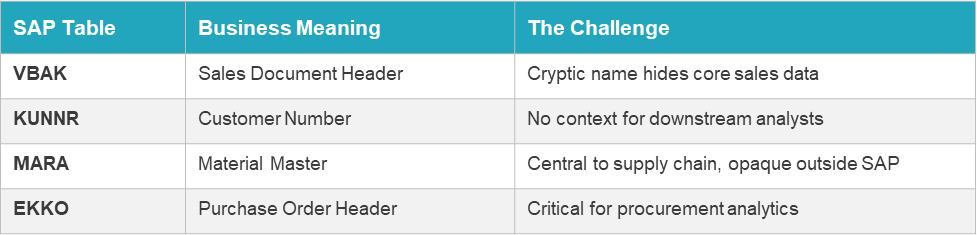
Why This Matters for AI
Most enterprise AI struggles are not model problems. They are context problems.
AI systems can only reason effectively when they understand the meaning behind enterprise data. In supply chains, that challenge becomes exponentially harder because operational decisions depend on relationships across planning, procurement, inventory, manufacturing, logistics, and customer demand.
Semantic metadata changes this dynamic.
- Natural-language querying becomes more effective because AI systems can interpret supply chain terminology in context.
- AI agents gain the ability to reason across business objects like materials, BOMs, purchase orders, inventory positions, and forecasts without requiring extensive custom mapping for every implementation.
- Business users who have never worked inside SAP can finally interact with operational data through understandable business language rather than cryptic technical structures.
The result is not simply better analytics. It is a more scalable foundation for enterprise AI adoption.
Why Supply Chain Is the Highest-Value Use Case
Finance often becomes the first AI showcase inside enterprises. But supply chain is where business context delivers the greatest operational value. Supply chains are inherently cross-functional and interconnected. A single planning decision may affect sourcing, manufacturing, warehousing, transportation, fulfillment, and customer service simultaneously. Most enterprises also operate across hybrid environments that include SAP alongside Kinaxis, Oracle, Blue Yonder, legacy systems, and internally developed platforms. The challenge is not simply moving data between systems.
The challenge is preserving meaning, relationships, governance, and operational context across the entire ecosystem.
That is where semantic synchronization becomes transformational. It closes the interpretation gap between planning systems and operational analytics — enabling faster decisions, stronger visibility, and more intelligent execution across the supply chain.
AI Enablement Across the Databricks Platform
The impact extends beyond metadata management. Semantic synchronization strengthens AI enablement across the Databricks Data Intelligence Platform.
Genie and AI/BI Dashboards
Natural-language queries on SAP supply chain data become significantly more effective because Genie understands business context. Queries like “Show me open purchase orders by plant” work because the platform can interpret supply chain terminology and relationships accurately.
Mosaic AI and Agent Systems
Domain-specific AI agents built on SAP data gain the semantic grounding needed to reason across supply chain objects such as materials, routings, inventory positions, and production structures — without extensive manual prompt engineering.
Databricks SQL and Notebooks
Business users and analysts who have never worked inside SAP GUI can interpret planning data, forecasts, inventory positions, and operational metrics through business-friendly metadata in Unity Catalog. The interpretation gap between planning systems and analytical platforms begins to close.
What Bristlecone Brings to the Databricks Ecosystem
Bristlecone operates at the intersection of SAP, supply chain, and AI transformation. For nearly three decades, we have helped enterprises navigate the complexity of planning, procurement, manufacturing, inventory, logistics, and fulfillment across global supply chains. That experience matters because business context in supply chains is not theoretical. It is operational. For decades, enterprises have relied on tribal SAP knowledge to interpret supply chain data. Bristlecone has spent nearly 30 years codifying that complexity across planning, manufacturing, procurement, logistics, and fulfillment environments. We understand how SAP modules connect, how planning decisions cascade across systems, and where interpretation gaps exist between operational platforms and analytical environments. At the same time, enterprises need modern data and AI architectures capable of operationalizing that intelligence at scale.
Bristlecone combines:
- Deep SAP and supply chain expertise
- Native Databricks platform capabilities
- AI and decision intelligence experience
- Process-led transformation knowledge
We do not bolt Databricks onto SAP as an afterthought. We architect natively on the Data Intelligence Platform to help enterprises move toward more connected, AI-ready supply chain ecosystems.
The Path Forward
As enterprises accelerate AI adoption, preserving business context across data ecosystems will become increasingly critical — especially in supply chain environments where operational complexity is highest. For organizations building AI and analytics capabilities on SAP and Databricks, semantic synchronization represents an important step toward more intelligent, connected, and scalable supply chain decision-making.
Connect with Bristlecone at Data + AI Summit 2026 to explore how enterprises can operationalize AI-ready supply chain data on Databricks.
June 15–18, 2026
Moscone Center, San Francisco
Learn more at bristlecone.com

Nanda Magatala
Data Architect
Bristlecone